Friday, 14 September 2012

For the Record - A Guide to Berlin's Best Record Stores

                                                         
Rotation Boutique
Address: Weinbergsweg 3, 10119, Mitte
U-Bahn: Rosenthaler Platz
Opening times: Mon-Sat 12pm-7pm
Website: rotation-records.de                                                
                                                               
Da Capo                                                           
Address: Kastanienallee 96, 10432, Prenzlauer Berg                   
U-Bahn: Eberswalder Straβe                                
Opening times: Tue-Fri 12pm-7pm, Sat 12pm-6pm                     
Website: da-capo-vinyl.com    


Core Tex                                                                Hardwax
Address: Oranienstraβe 3, 10997, Kreuzberg            Address: Paul-Lincke-Ufer 44, 10999, Kreuzberg
U-Bahn: Kottbusser Tor                                           U-Bahn: Kottbusser Tor
Opening times: Mon-Fri 11am-8pm, Sat 11am-6pm  Opening times: Mon-Sat 12pm-8pm
Website: coretexrecords.com                                           Website: hardwax.com
                                  

It seems that record stores are quickly becoming a thing of the past; with digital media causing low CD sales and the closure of major chains. Thankfully this problem doesn’t seem to have affected Berlin. The city is heaving with small, independent record stores that form the basis of its vast and diverse music scene.
Hardwax is a world renowned record store that has been at the heart of Berlin’s techno scene since its emergence in the early 80’s. The shop is very well hidden on the third floor of a rundown building set behind a row of shops that overlook the canal on Paul-Lincke-Ufer.  Inside the bare brick walls and sticker-coated steel door there is an extensive collection of techno, electronic and dubstep records from the US, UK and Europe. There is also an alcove at the back lined with DJ decks where you can listen to the latest club bangers before purchasing.
All you hardcore, punk and metal fans, who like your music with a bit more bite, should spike up your Mohawks and head down to Core Tex on Oranienstraβe. Here you will find an impressive selection of all things heavy, from metalcore to psychorockabilly as well as tickets to upcoming gigs. You can snatch up a classic LP for a bargain from one of the second hand/rarities bins in front of the counter. The store also sells badges, patches, pins and an array of t-shirts and hoodies, including their signature ‘Don’t Mess with Kreuzberg’ top. But no punk rocker is complete without owning a pair of classic Doc Martin boots, costing just over 100€.
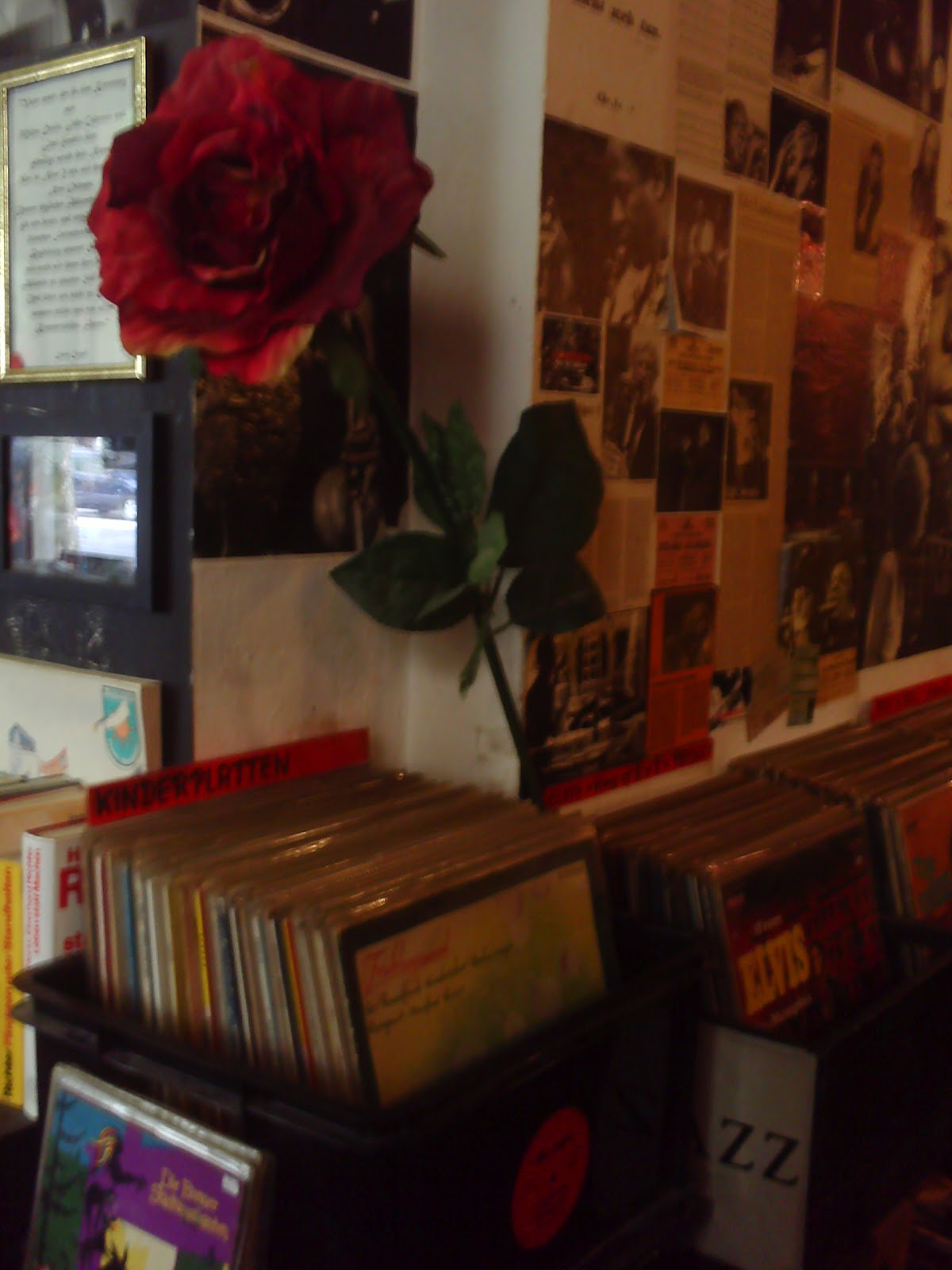
If you are more interested in your golden oldies then Da Capo, in Prenzlauer Berg, is the place to visit. The store, discernible by the group of locals outside smoking around an old petrol barrel, is a more traditional, dusty record store. The rooms are dimly lit, the walls cluttered with vintage posters and a black and white tarpaulin hanging from the ceiling. Flick through the shelves crammed with vintage pop, rock and soul vinyl from the 60’s and 70’s to discover some rare treasures. There is even a section dedicated records released during the GDR days. A small bookshop, selling German classics, is also squeezed into the tiny back room.
Rotation Boutique, in Mitte, is a stylish, modern record store. Once the centre of the city’s techno and house scene, it shifted focus in 2010 towards fashion. However if you search past the rails displaying overpriced shirts from independent designers you can still find a small yet rich selection of records. It remains a great place to pick up the latest releases in house/electronica as well as some classics from the second hand section stuffed in boxes at the back of the shop.



Balkan Beats

Dancing to Balkan Beats
Address: Revaler Straβe 99, 10245, Friedrichshain
U-Bahn: Wasser Straβe
Opening times: 10pm - late
Admission: 2€
Website: info@badehaus-berlin.com 
                  
Berlin is the birthplace of Balkan beats - a raucous musical genre that combines traditional Balkan songs with modern techno rhythms. Fiddles and accordions duel over electronic drum beats while heavy bass lines combine with blaring brass horns to create frantic, Eastern European dance tunes. This increasingly popular movement was the brainchild of DJ Robert Soko. Originally from Bosnia, he spent some time travelling around Europe before finally settling in Berlin soon after the wall had come down. His regular DJ sets at the Arcanoa in Kreuzberg soon became popular as punks as well as expats came to swig beer and Russian dance to traditional Baltic songs. Eventually he began mixing the music from his old country with the emerging techno scene in Berlin. Balkan beats was born.
There are some excellent Balkan beat nights set up around many clubs in Berlin. Kaffee Burger, made famous by the author Wladimir Kaminer in his novel Russian Disco, and Lido, where Soko still has a residency, both have regular Balkan nights that keep the people dancing and the vodka flowing. However for a particularly authentic experience you should head to the Hungarian Badehaus bar located in the Raw complex, an abandoned train station in Friedrichshain that has been transformed into a thriving nightspot littered with clubs and bars. The Badehaus building was originally used as a bath house for the railway repair workers. It still retains some of the buildings features such as the wooden beams at the centre of the bar and the high ceilings lined with small windows. Bright murals cover the walls and are illuminated by light fixtures made from ornate bath taps. You can drink a traditional Hungarian wine at one of the tables made out of film canisters before heading to the dance floor in the next room. On Balkan beat night you will find everyone here, from punks and ravers, to old, Eastern Europeans swinging each other round as the trumpets flair and the bass pounds the walls. It is not as expensive as other Balkan beat nights, just 2€ to enter and 3€ for a large beer. If you head there early you can also enjoy a traditional Hungarian meal to give you sustenance for the long, wild night you have in store. 

Club de Visionaere


Down by the River at Club de Visionaere
Address: Am Flutgraben, 12435, Treptow  
U-Bahn: Schlesisches Tor
Opening times: Mon - Fri 2pm - late, Sat-Sun 12pm - late
Admission: 5€ -10€
Website: clubdevisionaere.de

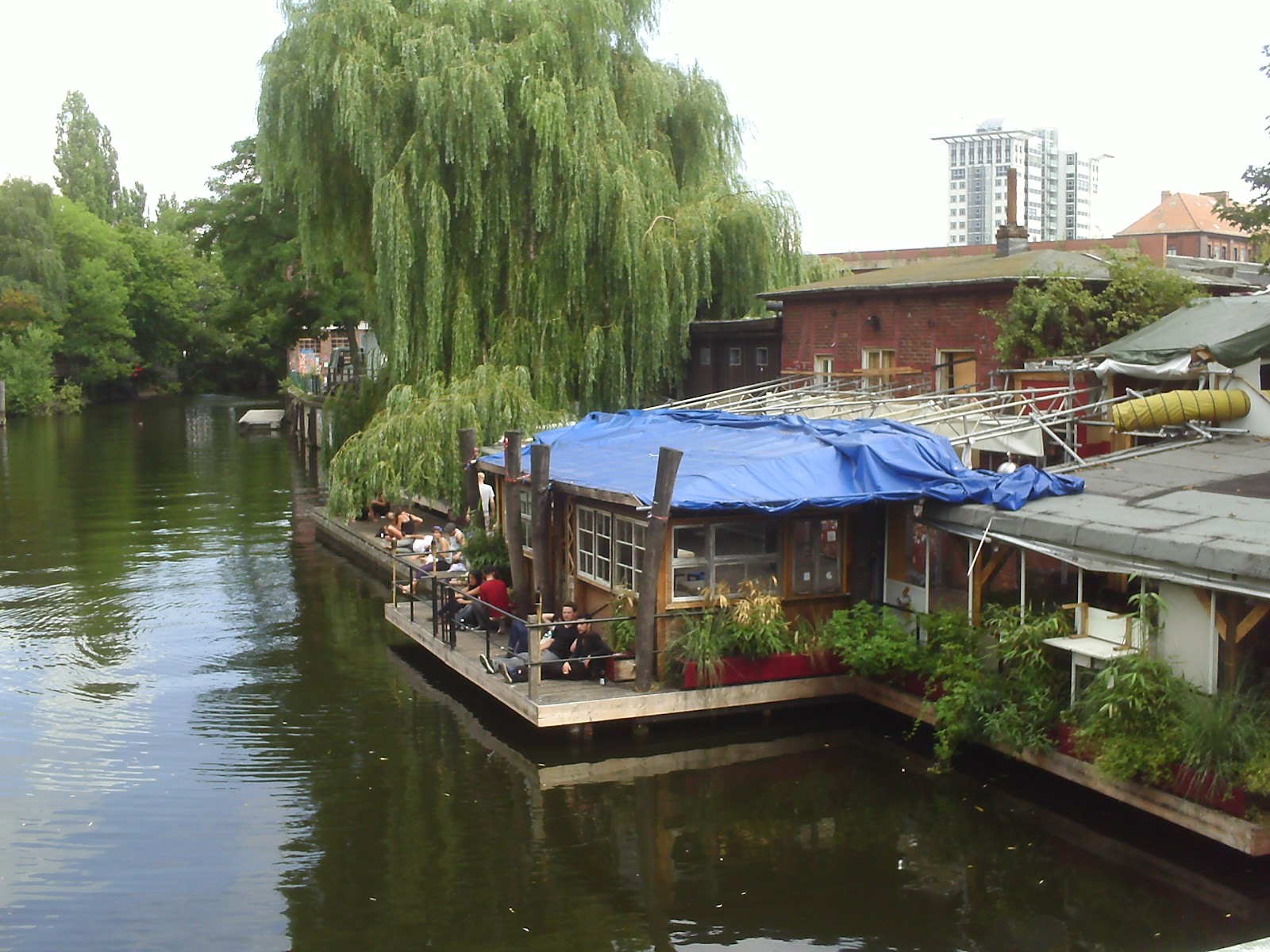
This club, overlooking Landwehr canal, is an excellent place to sup a chilled beer in the summer sun while nodding along to the latest dance tunes. It may look like a lopsided shed with a tarpaulin roof built vicariously around a tree that juts out from the riverbank, but don’t let appearances fool you. Walk down to the platform by the riverside, buy a cocktail from the bar and sit upon the wooden decking suspended over the water. From here you can spend the afternoon watching boats drift down the river while a DJ plays ambient techno tunes from decks situated in the small dance floor. Upstairs you will find a beer garden with benches overlooking the boardwalk below. Pizza is served from a small hut at the back for 3€ so you can enjoy your lunch while dangling your feet over the water’s edge.
When the sun begins to set over the canal the venue’s atmosphere changes. Lanterns are lit on the decking, the huge willow tree is illuminated and the techno turned up. The romantic setting is soon transformed into a rowdy club where cooler-than-thou hipsters come to dance to Berlin’s hottest new DJs. The crowds spill out from the cramped dance floor and onto the platform where the thumping bass shakes the decking that separates you from the water. Unfortunately the clubs increasing popularity means that it can get overcrowded and you may be waiting ages simply to get in. At night there is an entrance fee of between 2€ to 5€, although in the day you have to pay 2€ extra with your first beer for the DJ. It is best to arrive just before sunset when you can enjoy a few beers in the beautiful setting before the night really begins.   

Friday, 31 August 2012

Museum of Musical Instruments

Inside the Museum of Musical Instruments
Address: Tiergartenstraβe 1, 10785, Mitte
S-Bahn: Potsdamer Platz 
Opening times: Tue, Wed, Fri 9am - 5pm, Thu 9am -10pm,
                            Sat -Sun 10am-5pm
Admission: 4€


Tucked away behind the mustard coloured Philharmonic Hall is this museum of all things musical. Opened in 1888, the museum documents the history and evolution of musical instruments from the 16th century to present day.
The deceptively large museum, holding around 800 instruments, is divided into two floors. The ground floor displays instruments from the 16th and 17th century. Here you will find opulently decorated harpsichords, hurdy-gurdies, and the rather unfortunately named fagott horn. The highlight has to be The Mighty Wurlitzer theatre organ which sounds and looks like a prop from a cheesy Sc-Fi movie. Visit at noon on Saturday for a chance to see a live demonstration of this bizarre instrument.
Upstairs the exhibition, which covers the period from the 18th century to the present day, has a smaller collection on display. The instruments become more recognisable and you begin to think the museum is pushing its luck with a display of piano tools. Still there are some intriguing instruments such as the model synthesiser that Pink Floyd used in their song ‘Welcome to the Machine’.  When you pay the snobbish attendants your 4€ entrance fee ask them for a free English audio guide (they will not offer you one). After the general introduction, read by a rather creepy sounding man, you can listen to samples of music played by the instruments on display. You can hear elegant harps, bassett horns (which look uncannily like artificial limbs) and a 16th century serpent horn that sounds like a man blowing raspberries into a rusty bucket. The whole museum takes about an hour and offers great insight into the history of music. It is just a shame that you are not actually allowed to play anything.